
Learn essential cybersecurity skills through hands-on practice, practical projects, and structured learning to build your portfolio and prepare for a cybersecurity career.
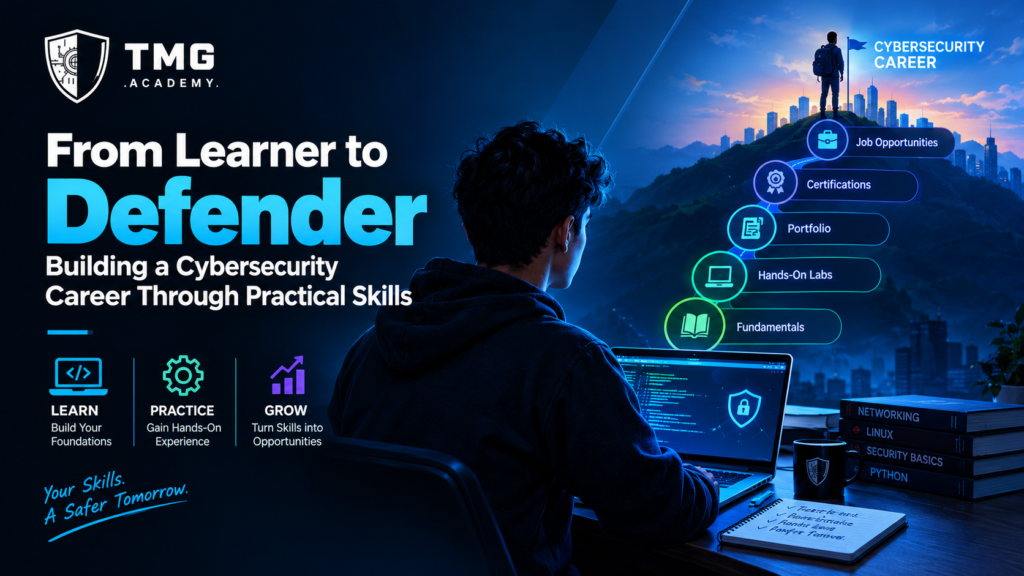
<h1>From Learner to Defender: Building a Cybersecurity Career Through Practical Skills</h1>
Introduction
Cybersecurity is a constantly evolving field that requires curiosity, problem-solving, technical knowledge, and continuous learning. For beginners, the number of available courses, certifications, tools, and career paths can make getting started feel overwhelming.
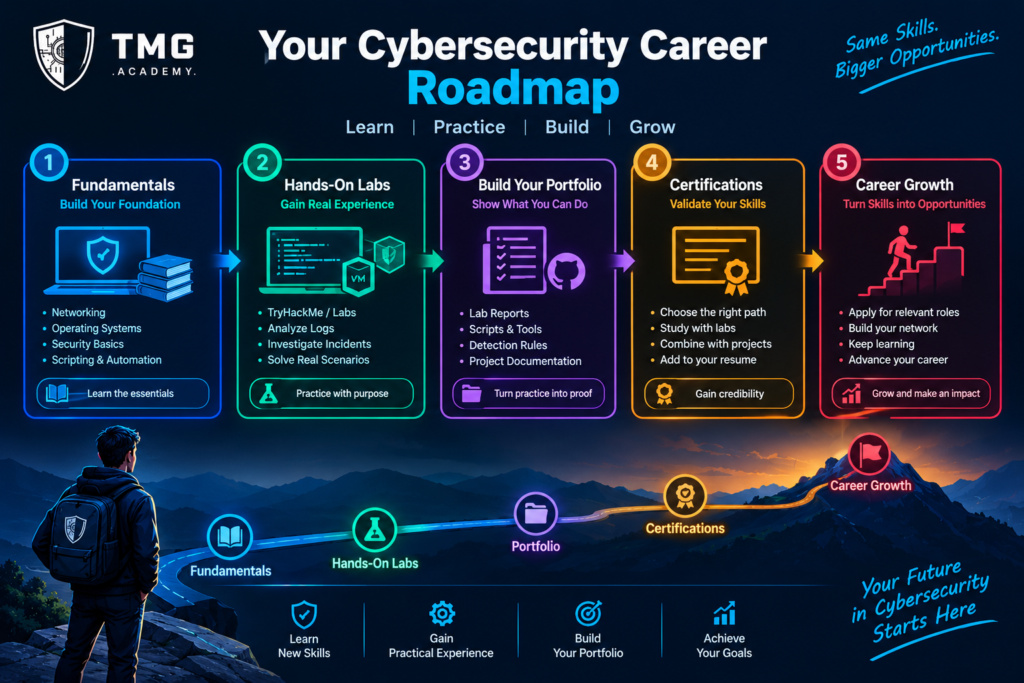
The solution is not to learn every tool or collect every certification. It is to build strong fundamentals, practice consistently, document what you learn, and gradually develop the skills needed for a specific role.
This article presents a practical roadmap for aspiring cybersecurity professionals who want to turn learning into demonstrable skills and build a sustainable career.
1. Understand the Cybersecurity Career Landscape
Cybersecurity includes several specializations, each with different responsibilities and skill requirements.
Security Operations Center (SOC) Analyst: Monitors security alerts, analyzes logs, investigates suspicious activity, and supports incident response.
Penetration Tester: Evaluates authorized systems for security weaknesses and provides evidence-based remediation recommendations.
Blue Team Analyst: Improves defensive controls, develops detections, investigates threats, and strengthens an organization's security posture.
Digital Forensics and Incident Response (DFIR) Analyst: Examines digital evidence, reconstructs events, and supports investigations into security incidents.
Cloud Security Engineer: Helps protect cloud infrastructure, identities, workloads, configurations, and sensitive data.
Application Security Engineer: Helps developers identify and address security weaknesses throughout the software development lifecycle.
Beginners do not need to choose a permanent specialization immediately. Exploring introductory material from several areas can help identify which work best matches their interests.
2. Build Strong Technical Foundations
Before focusing on advanced security tools, develop an understanding of the technologies those tools protect.
Networking
Learn the fundamentals of IP addressing, DNS, HTTP and HTTPS, routing, common ports, firewalls, and network communication.
Understanding how systems communicate makes it easier to recognize suspicious connections and investigate network-related alerts.
Operating systems
Become comfortable with Linux and Windows fundamentals, including users, permissions, processes, services, filesystems, and event logs.
For defensive work, learn where systems record authentication events, process activity, configuration changes, and security-relevant errors.
Scripting and automation
Start with Python or PowerShell, depending on your learning goals.
Practice reading structured data, processing text files, working with timestamps, parsing logs, and automating repetitive tasks. You do not need to become an advanced programmer before beginning cybersecurity practice.
Security fundamentals
Study authentication, authorization, encryption, access control, vulnerability management, risk assessment, logging, and incident response.
These concepts appear across nearly every cybersecurity specialization.
3. Learn by Doing, Not Just Watching
Videos and tutorials can introduce concepts, but practical exercises help turn knowledge into usable skills.
Create a small, isolated learning environment using systems you own or are explicitly authorized to test. Use deliberately vulnerable training applications, simulated security events, and sample log datasets.
Begin with manageable projects such as:
-
Analyzing authentication logs to identify unusual login patterns.
-
Investigating a simulated phishing email using its headers and observable indicators.
-
Writing a simple script to summarize failed login events.
-
Creating a basic incident timeline from sample endpoint logs.
-
Reviewing a lab application's security configuration and documenting improvements.
-
Writing a detection rule for a clearly defined, simulated security event.
For every project, record the objective, environment, steps performed, observations, limitations, and recommended improvements.
A project that demonstrates clear reasoning is often more valuable than a long list of tools you have merely opened.
4. Build a Portfolio That Demonstrates Your Skills
A cybersecurity portfolio gives employers and mentors tangible evidence of your learning.
You can publish sanitized lab reports, scripts, detection rules, diagrams, incident timelines, and defensive configuration guides.
A useful project report should include:
Objective: What question or security problem did you investigate?
Environment: Which operating system, tools, dataset, or authorized lab did you use?
Method: What steps did you follow, and why?
Evidence: What logs, outputs, screenshots, or observations support your findings?
Results: What did you discover, and what remains uncertain?
Remediation: What changes would improve security?
Lessons learned: What would you do differently next time?
Remove credentials, tokens, personal information, private logs, and other sensitive data before publishing anything. Obtain permission before sharing information about an employer, client, or third-party system.
The goal is to demonstrate your reasoning and practical ability without exposing confidential information.
5. Choose Certifications Strategically
Certifications can provide structure, validate selected knowledge, and help demonstrate commitment to a learning path. However, they do not replace practical experience.
Choose a certification based on your target role, current knowledge, budget, and the requirements of jobs you intend to pursue.
For example, beginners may explore foundational IT and security certifications, while people targeting SOC roles may benefit from training in log analysis, SIEM concepts, endpoint monitoring, and incident response.
Before paying for an exam, review its official objectives and compare them with job descriptions in your target market.
A useful approach is to combine structured study with a related project. If you study network security, build a network-analysis lab. If you study incident response, investigate a sample incident and write a report.
This makes the learning more practical and helps you explain what you know.
6. Develop Professional Skills Alongside Technical Skills
Technical ability is only one part of effective cybersecurity work.
Security professionals must explain findings, document evidence, prioritize risks, collaborate with other teams, and communicate uncertainty.
Practice writing concise investigation reports that distinguish observed facts from assumptions. Learn to explain technical issues in language that nontechnical stakeholders can understand.
Develop the habit of asking:
-
What evidence supports this conclusion?
-
What other explanation could account for the observation?
-
How serious is the risk?
-
What should be done first?
-
How can the fix be verified?
These questions help transform technical observations into useful security decisions.
7. Follow a Practical 90-Day Learning Roadmap
The following plan is a flexible starting point. Adjust the pace to fit your existing knowledge and available study time.
Days 1–30: Build the foundation
Focus on networking, operating systems, security concepts, and basic command-line skills.
Deliverable: A short technical report explaining a network concept or a set of sample system logs.
Days 31–60: Practice a specialization
Choose an introductory direction such as SOC analysis, Blue Team operations, penetration testing in authorized labs, or cloud security.
Complete guided exercises and repeat selected tasks without relying entirely on the tutorial.
Deliverable: One documented, hands-on security project.
Days 61–90: Create and present a portfolio
Complete a second project, improve the first, organize your documentation, and practice explaining your decisions.
Review entry-level job descriptions and identify gaps between your current skills and the role's requirements.
Deliverable: A small portfolio containing two well-documented projects, a focused résumé, and a plan for the next stage of learning.
This roadmap is not a guarantee of employment. Its purpose is to provide structure and create measurable progress.
8. Use Learning Platforms Responsibly
Cybersecurity training platforms can provide structured exercises and realistic practice environments.
When selecting a platform, consider whether it teaches the fundamentals, explains the reasoning behind tasks, provides feedback, and allows you to practice safely.
Treat lab completion as the beginning of learning rather than the final objective. After finishing an exercise, try to explain the underlying concept, identify its limitations, and describe how the lesson applies to real defensive work.
Always stay within the platform's authorized environment and follow its rules. Never test public systems or other people's accounts without explicit permission.
9. Avoid Common Career-Building Mistakes
Collecting certificates without practicing: Balance study with projects that demonstrate applied knowledge.
Learning too many tools at once: Understand the problem a tool solves before adding another one to your workflow.
Copying walkthroughs without understanding them: Reproduce the exercise independently and explain why each step matters.
Waiting until you feel completely ready: Build a foundation, practice consistently, and apply for suitable opportunities while continuing to learn.
Ignoring documentation: Record your process and evidence so other people can understand and evaluate your work.
Chasing every new trend: Prioritize durable fundamentals before moving into specialized or emerging technologies.
Comparing progress with others: People enter cybersecurity with different backgrounds, resources, and amounts of available time. Measure progress through the skills you can demonstrate and the problems you can solve.
10. Create a Sustainable Learning Routine
Consistency is more useful than an unrealistic schedule that is difficult to maintain.
A manageable routine might include reviewing a core concept, completing a practical exercise, documenting the result, and revisiting mistakes.
Keep a learning journal with three simple entries:
<ol start="1">
What did I learn?
What can I demonstrate independently?
What do I need to improve next?
</ol>
Review your progress regularly and update your goals when your interests or career plans change.
You do not need to master everything at once. Each completed project, improved report, and better-understood concept contributes to your development.
Conclusion
Building a cybersecurity career is a process of developing knowledge, practicing responsibly, demonstrating skills, and learning from mistakes.
Start with the fundamentals, explore a career direction, create practical projects, document your results, and use certifications strategically. Combine technical ability with clear communication, ethical judgment, and a willingness to improve.
The most important measure of progress is not the number of tools you know or certificates you collect. It is your ability to explain a security problem, investigate it systematically, support your conclusions with evidence, and recommend an effective solution.
Learn with purpose. Practice with permission. Document your progress. Build skills that make systems safer.
References and Further Learning
<ol start="1">
NIST NICE Workforce Framework for Cybersecurity — https://www.nist.gov/itl/applied-cybersecurity/nice/nice-framework-resource-center
CISA Cybersecurity Best Practices — https://www.cisa.gov/topics/cybersecurity-best-practices
MITRE ATT&CK — https://attack.mitre.org/
OWASP — https://owasp.org/
Cisco Networking Academy — https://www.netacad.com/
TryHackMe — https://tryhackme.com/
</ol>
Ethical note: All practical testing should be performed on systems you own or have explicit authorization to assess. Respect privacy, platform rules, and responsible disclosure requirements.
 🎓 Want to go deeper?Securestart Cybersecurity Training (Assured Internship)Hands-on course by TMG Security →
More from the TMG Security blog

Community posts reflect the author's own experience. Only test systems you have permission to test.
