
Learn how SOC and Blue Teams use threat detection, log analysis, and incident response to identify threats, reduce false positives, and strengthen cybersecurity defenses.
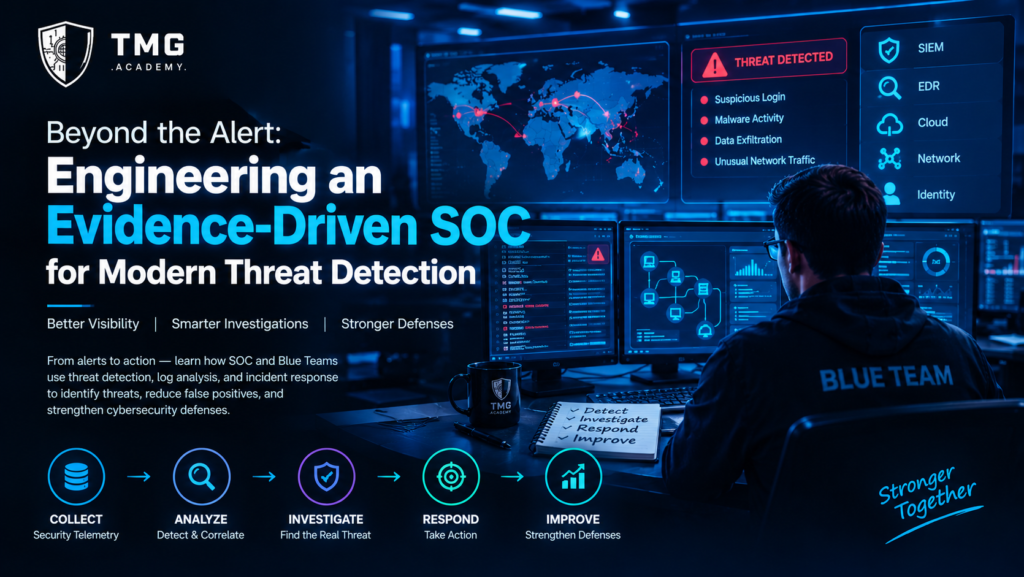
<h1>Beyond the Alert: Engineering an Evidence-Driven SOC for Modern Threat Detection</h1>
Abstract
Security Operations Centers (SOCs) operate in an environment where endpoints, identities, cloud services, networks, and applications generate enormous amounts of security telemetry. However, collecting more logs does not automatically produce better security outcomes. Poorly tuned detections, fragmented visibility, incomplete context, and inconsistent investigation procedures can prevent analysts from identifying meaningful threats.
Modern Blue Team operations must therefore move beyond alert monitoring toward evidence-driven detection engineering. This article presents a practical framework for connecting telemetry, validating suspicious activity, investigating related events, and continuously improving defensive controls. It also introduces a proposed Detection Evidence Chain, a practical model for evaluating whether an alert contains enough reliable evidence to support a security decision.
1. The Problem: More Alerts Do Not Always Mean Better Security
A typical SOC receives alerts from endpoint detection and response (EDR), security information and event management (SIEM), identity providers, firewalls, email security platforms, cloud audit services, and other defensive technologies.
Each source contributes a different perspective. An endpoint tool might identify suspicious process behavior, while identity logs show an unusual sign-in and a cloud audit trail records an unexpected permission change.
Individually, these events may appear ambiguous. Correlated together, they may reveal a meaningful security incident.
Three recurring problems make this difficult:
-
Alert overload: Large volumes of low-value notifications compete with genuine threats for analyst attention.
-
Context gaps: Alerts may lack the identity, asset, process, network, or timeline information needed for investigation.
-
Detection blind spots: Security controls may fail to observe relevant activity or may generate alerts that cannot be reliably validated.
The objective of a mature SOC is not simply to produce more alerts. It is to produce actionable detections supported by trustworthy evidence.
2. Understand the Detection Pipeline
An evidence-driven SOC can be understood as a pipeline with six stages.
Stage 1: Telemetry collection
Collect relevant security events from authorized and monitored systems, such as:
-
Endpoint process and authentication events.
-
Identity-provider sign-ins and access changes.
-
DNS, proxy, firewall, and network-flow records.
-
Cloud control-plane and audit events.
-
Email security and application logs.
Collection should be guided by detection requirements rather than volume alone. Every important data source should have an identified owner, a documented purpose, and a retention policy.
Stage 2: Normalization and enrichment
Different tools often represent the same information differently. One source may identify a user through an email address, while another uses an internal account identifier.
Normalize important fields and enrich events with relevant context, including:
-
Asset criticality and ownership.
-
User identity and privilege level.
-
Event timestamps and source reliability.
-
Known maintenance windows and approved administrative activity.
-
Threat intelligence, where relevant and validated.
Enrichment improves investigation quality, but analysts must distinguish verified facts from inferred context.
Stage 3: Detection logic
Detection rules identify behavior that may indicate a security issue.
Examples include unusual authentication patterns, unexpected privilege changes, suspicious process relationships, or deviations from an established operational baseline.
A reliable detection should document:
<ol start="1">
The behavior being detected.
The required log sources and fields.
The logic and assumptions behind the rule.
Known benign explanations.
Expected limitations and blind spots.
The investigation steps an analyst should follow.
</ol>
A rule that depends on unavailable or inconsistently collected telemetry may provide a false sense of coverage.
Stage 4: Correlation and prioritization
Correlation connects events that share relevant attributes, such as a user, host, session, process, or time window.
For example, a new sign-in location alone may not prove malicious activity. The same event combined with an unusual authentication pattern, a sensitive account change, and unexpected access to a critical resource may deserve a more detailed investigation.
Correlation should not automatically convert every sequence of events into a confirmed incident. Shared identifiers, timestamp accuracy, event provenance, and alternative explanations must be evaluated.
Stage 5: Investigation and response
Analysts examine the evidence, determine what is known, identify what remains uncertain, and follow the organization's incident-response procedures.
Depending on the findings and their authority, responders may escalate an incident, preserve evidence, disable a compromised session, isolate an affected endpoint, or implement other approved containment actions.
High-impact actions should follow documented authorization and change-control procedures, particularly when they could interrupt business-critical services.
Stage 6: Feedback and improvement
After an investigation, the SOC should review whether the detection worked as intended.
Useful questions include:
-
Did the necessary telemetry exist?
-
Was the alert generated promptly?
-
Did the rule identify the relevant behavior?
-
How much manual work was needed to validate it?
-
Did the investigation procedure provide sufficient guidance?
-
What change would improve the next investigation?
This feedback turns incident handling into a continuous detection-engineering process.
3. The Detection Evidence Chain
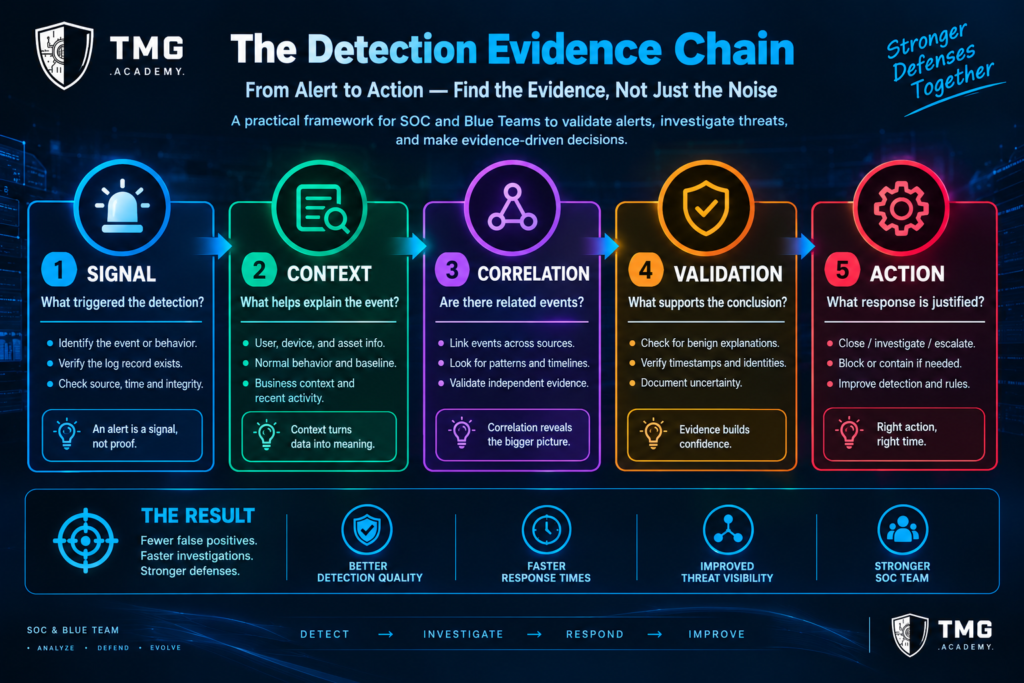
The Detection Evidence Chain (DEC) is a proposed practical framework for reviewing the quality of SOC detections. It is an original organizing model for this article, not an official industry standard.
The framework evaluates five connected elements.
A. Signal
What specifically triggered the detection?
The analyst should identify the relevant event or behavior and verify that the underlying record exists. An alert title alone is not sufficient evidence.
B. Context
What surrounding information helps explain the event?
Context may include the affected asset, account privileges, recent related activity, expected operating patterns, and relevant business processes.
C. Correlation
Are there independent events that support or contradict the initial hypothesis?
Correlated evidence can strengthen an investigation, but duplicate events or records derived from the same underlying source should not be mistaken for independent confirmation.
D. Validation
What evidence supports the conclusion?
The analyst should consider benign explanations, validate timestamps and identities, and document uncertainty. A detection can indicate suspicious behavior without proving that a compromise occurred.
E. Action
What response is justified by the available evidence?
Possible outcomes include closing the alert as benign, tuning the detection, requesting further investigation, escalating to incident response, or initiating an approved containment procedure.
The key principle is simple: every important security decision should be traceable to evidence, an explicit rationale, and an authorized action.
4. Practical Investigation Example: Suspicious Account Activity
Consider a fictional organization that receives an alert about unusual sign-in activity involving an employee account.
The alert is not automatically proof of account compromise. A structured investigation can establish whether the activity is expected or suspicious.
Step 1: Validate the original event
Review the identity-provider record, event timestamp, authentication result, source information, and available session details.
Confirm that the event belongs to the correct account and that the log record has not been misinterpreted.
Step 2: Establish the baseline
Determine whether the activity is consistent with the user's normal responsibilities, approved travel, remote-access arrangements, or scheduled administrative work.
Avoid treating location or unfamiliarity alone as conclusive evidence of malicious activity.
Step 3: Search for related activity
Within authorized logging systems, review relevant events surrounding the alert, such as repeated authentication failures, changes to authentication methods, privilege modifications, or unusual access to sensitive resources.
Use a consistent timeline and record which sources support each observation.
Step 4: Build competing hypotheses
For example:
-
The user performed legitimate activity from an unfamiliar environment.
-
A legitimate service or administrative process generated the event.
-
An unauthorized party may have obtained access to the account.
Identify what evidence would support or weaken each hypothesis instead of deciding too early.
Step 5: Determine the appropriate response
If the evidence supports a credible compromise, follow the organization's incident-response process. Depending on policy and risk, actions may include revoking sessions, requiring credential recovery, reviewing account permissions, and checking for additional affected systems.
Preserve relevant logs and document the rationale for each action.
Step 6: Improve the detection
After the investigation, determine whether the alert could be improved through better enrichment, clearer thresholds, additional identity context, or more precise analyst instructions.
The result should be a stronger detection, not simply a closed ticket.
5. Reducing False Positives Without Creating Blind Spots
False positives consume analyst time, but aggressive suppression can hide real threats. Effective tuning requires evidence and measurement.
A disciplined tuning process includes:
<ol start="1">
Establish a baseline: Measure alert volume, investigation outcomes, and recurring benign patterns.
Identify the actual cause: Determine why the rule triggered rather than suppressing an event simply because it was inconvenient.
Apply narrow changes: Prefer specific conditions based on verified business context over broad exclusions.
Test against representative data: Evaluate both known benign events and relevant suspicious scenarios.
Monitor the change: Compare alert quality and detection coverage after deployment.
Retain a rollback path: Document the previous rule and the reason for the modification.
</ol>
For example, excluding every event generated by a particular administrative account may hide misuse of that account. A narrower condition based on an approved system, expected operation, and verified time window may reduce noise with less loss of visibility.
Tuning should be treated as a controlled change to a security control.
6. Detection Coverage: Measure What the SOC Can Actually See
A detection catalog should connect important threat scenarios to the telemetry and logic required to identify them.
The MITRE ATT&CK knowledge base can help defenders map adversary behaviors to potential detection opportunities. However, mapping a detection to a technique does not by itself demonstrate that the detection is effective.
For each important scenario, document:
-
Relevant adversary behavior.
-
Required data sources.
-
Detection logic and known limitations.
-
Test method and expected result.
-
Investigation guidance.
-
Responsible owner and review date.
Where appropriate, use approved simulations, replayed test events, or controlled lab activity to verify that the expected telemetry is collected and the detection behaves correctly.
A missing alert should trigger investigation into the cause: perhaps the event was never logged, the data source was unavailable, the rule did not match, or the alerting pipeline failed.
These failure modes require different corrective actions.
7. Metrics That Reflect Detection Quality
Metrics are useful when they support decisions rather than merely reward activity.
Consider tracking the following measures.
Mean time to detect (MTTD): The average time between a defined event or incident starting point and its detection. The measurement must define its start and end points consistently.
Mean time to respond (MTTR): An operational measure of response time. Organizations should specify whether they mean time to respond, remediate, or recover, because these are different outcomes.
Alert validation rate: The proportion of reviewed alerts that meet a clearly defined validation criterion.
Data-source health: The availability, freshness, completeness, and parsing quality of required telemetry.
Detection test pass rate: The proportion of documented detection tests that produce their expected results.
Recurrence rate: How frequently previously addressed detection or investigation weaknesses appear again.
Investigation evidence completeness: The proportion of cases containing the required timeline, source records, analyst rationale, disposition, and response documentation.
Metrics should be interpreted together. A shorter response time is not necessarily an improvement if investigations become less accurate or important evidence is overlooked.
8. Building a Repeatable Blue Team Workflow
A practical SOC workflow should be consistent enough to repeat but flexible enough to handle unusual incidents.
For every significant alert, record:
-
Alert identifier and detection-rule version.
-
Relevant users, hosts, assets, and time range.
-
Original evidence and its source.
-
Enrichment and correlation results.
-
Alternative explanations considered.
-
Investigation findings and confidence level.
-
Escalation or response actions.
-
Final disposition and lessons learned.
Use role-based access controls to protect sensitive security data, and establish retention requirements for logs and investigation records.
Documenting the investigation makes handoffs easier, supports later reviews, and helps detection engineers identify recurring weaknesses.
Automation can assist with enrichment, deduplication, evidence collection, and case creation. High-impact response actions should have appropriate authorization, safeguards, and human oversight where required by organizational policy.
9. Common SOC Engineering Mistakes
Mistake 1: Treating every alert as a confirmed incident
An alert is a signal requiring evaluation. Clear incident criteria and evidence-based triage help prevent premature conclusions.
Mistake 2: Collecting logs without defining their purpose
Telemetry that is poorly parsed, unavailable when needed, or unrelated to detection requirements adds operational cost without necessarily improving coverage.
Mistake 3: Suppressing noise without testing detection impact
Broad exclusions can create blind spots. Every meaningful rule change should be tested and monitored.
Mistake 4: Relying on a single indicator
A single IP address, geographic location, or unusual process may have legitimate explanations. Investigations should consider the wider context.
Mistake 5: Measuring success only by ticket closure
Closing tickets quickly does not demonstrate that threats were identified accurately. Quality, coverage, evidence completeness, and recurrence matter too.
Mistake 6: Failing to learn from incidents
If investigation findings never improve rules, playbooks, telemetry, or training, the SOC repeatedly pays the cost of the same weaknesses.
10. Recommended Implementation Roadmap
Organizations can adopt evidence-driven detection engineering incrementally.
Phase 1 — Establish visibility: Inventory essential systems, identify critical log sources, and verify collection and parsing health.
Phase 2 — Standardize investigations: Define triage criteria, evidence requirements, escalation paths, and case documentation.
Phase 3 — Prioritize detections: Select important threat scenarios based on organizational risk, available telemetry, and defensive priorities.
Phase 4 — Test and tune: Use approved test cases, validate detection behavior, and make controlled changes supported by evidence.
Phase 5 — Measure outcomes: Review detection quality, data-source health, investigation consistency, and unresolved coverage gaps.
Phase 6 — Continuously improve: Feed lessons from investigations and authorized exercises back into detection logic, response procedures, and telemetry requirements.
This roadmap can be adapted to small security teams as well as larger SOC environments. The priority is to establish reliable fundamentals before introducing unnecessary complexity.
Conclusion
A modern SOC is more than a collection of monitoring tools. It is a decision-making system that transforms security telemetry into defensible conclusions and appropriate responses.
Better defensive outcomes depend on trustworthy logs, meaningful correlation, carefully tested detection logic, repeatable investigations, and continuous feedback. The proposed Detection Evidence Chain provides a practical way to evaluate whether a detection is supported by sufficient context and whether the resulting response is justified.
The ultimate objective is not to eliminate every false positive or detect every possible threat. It is to improve visibility, reduce uncertainty, identify important gaps, and make security decisions that can be explained, tested, and improved.
Collect the evidence. Validate the signal. Understand the context. Improve the detection.
References and Further Reading
<ol start="1">
MITRE ATT&CK — https://attack.mitre.org/
NIST SP 800-61 Rev. 3, Incident Response Recommendations and Considerations for Cybersecurity Risk Management — https://csrc.nist.gov/pubs/sp/800/61/r3/final
NIST Cybersecurity Framework — https://www.nist.gov/cyberframework
Sigma, Generic Signature Format for SIEM Systems — https://sigmahq.io/
MITRE Center for Threat-Informed Defense — https://ctid.mitre.org/
CISA, Cybersecurity Best Practices — https://www.cisa.gov/topics/cybersecurity-best-practices
</ol>
Scope and ethics: The investigation examples are illustrative. Testing, log access, simulations, and response actions should be performed only within authorized environments and in accordance with organizational policy.
 🎓 Want to go deeper?Certified Splunk SOC AnalystHands-on course by TMG Security →
More from the TMG Security blog


Community posts reflect the author's own experience. Only test systems you have permission to test.
