
Finding a vulnerability is only one part of an effective red-team assessment. This article introduces an evidence-driven framework for connecting attack-path analysis, controlled adversary emulation, defensive visibility, and measurable business risk—helping security teams distinguish a successful t
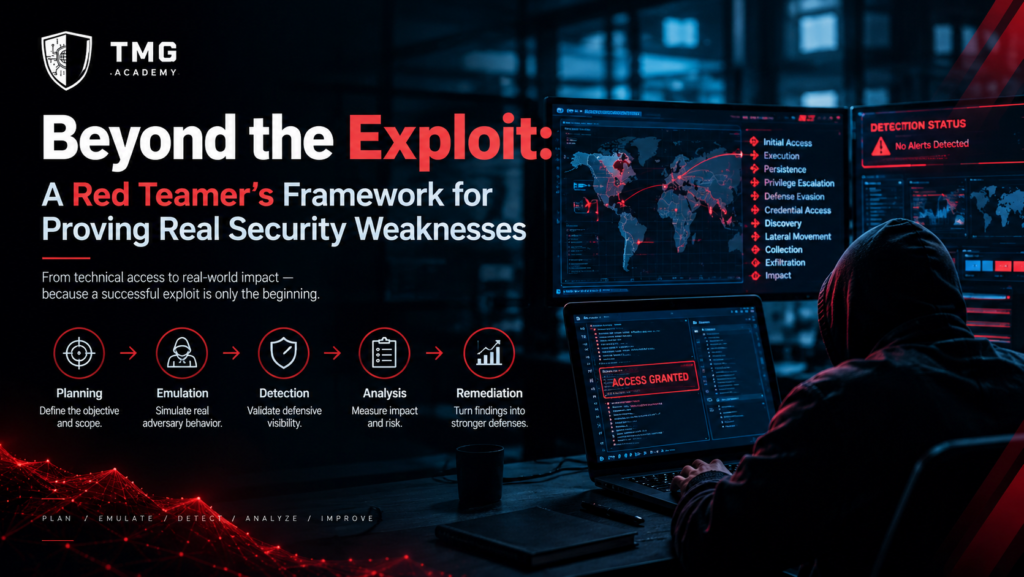
<h1>Beyond the Exploit: A Red Teamer’s Framework for Proving Real Security Weaknesses</h1>
Category: Penetration Testing & Bug Bounty
Focus: Red Team Operations, Adversary Emulation, Attack-Path Analysis, Detection Engineering
Abstract
A successful penetration test can demonstrate that a security control has failed. However, the presence of a vulnerability, the ability to exploit it, and the ability to achieve a meaningful adversarial objective are three different findings.
This distinction becomes particularly important during red-team assessments, where the objective is not simply to discover weaknesses but to evaluate how technical controls, monitoring systems, and response procedures perform under realistic, authorized testing conditions.
This article presents an evidence-driven assessment model that connects attack-path analysis, controlled adversary emulation, detection validation, and risk-based reporting. It also proposes a practical method for evaluating whether each test produces defensible evidence rather than merely an interesting technical result.
The central argument is straightforward: a red-team assessment should measure not only what a tester can accomplish, but also what the organization can detect, investigate, contain, and learn from the activity.
1. The Problem With Measuring Red-Team Success by Exploitation Alone
Imagine two authorized security assessments.
In the first assessment, a tester identifies an exposed administrative interface, validates a security weakness, and documents the finding. The technical objective is achieved.
In the second assessment, a tester validates a comparable weakness, traces its potential impact through the application's trust relationships, determines which security events are generated, and evaluates whether the organization's monitoring and response processes identify the activity.
Both assessments may discover a valid vulnerability.
However, they answer different questions.
The first establishes a technical weakness. The second examines the relationship between that weakness and the organization's wider security posture.
This distinction does not make conventional penetration testing less valuable. Focused vulnerability validation is essential for identifying and fixing individual weaknesses. Rather, it highlights why a red-team assessment requires a broader measurement model.
A technically successful operation does not automatically prove that an organization is resilient, and an unsuccessful exploitation attempt does not automatically prove that its defenses are effective.
The outcome depends on the test objective, the permitted scope, the evidence collected, and the limitations of the assessment.
A meaningful red-team result is not simply proof that a technique worked. It is evidence that answers a defined security question.
2. Start With an Adversarial Objective, Not a Tool
Red-team planning can become tool-centric surprisingly quickly.
A team may begin by discussing scanners, exploitation frameworks, endpoint testing utilities, or attack simulation platforms before defining the security question the engagement should answer.
That reverses the proper order of operations.
A defensible assessment begins with a clearly stated objective.
For example:
-
Can an unauthorized user gain access to a protected application function?
-
Can an account with limited privileges access resources beyond its intended authorization?
-
Would the monitoring team recognize a defined sequence of suspicious administrative actions?
-
Can the incident-response team reconstruct a simulated compromise using the available evidence?
-
Do controls prevent a low-trust identity from reaching a designated high-impact resource?
These objectives are specific enough to test and meaningful enough to guide remediation.
The tools come later, selected according to the approved scope and the evidence required.
From a vague objective to a testable hypothesis
Consider the statement:
"Our organization needs better detection."
This is too broad to evaluate objectively.
A stronger hypothesis would be:
"When a designated test account performs a predefined sequence of authorized administrative actions, the monitoring system will generate the expected telemetry, correlate the relevant events, and notify the appropriate response team within the agreed threshold."
This hypothesis establishes observable conditions.
The test can then compare expected behavior with actual results, document any deviations, and identify which control requires improvement.
The value lies in making the security question falsifiable. The team must be able to discover that its original assumption was incorrect.
3. Model the Attack Path as a Chain of Trust Decisions
A vulnerability rarely exists in isolation from the system around it.
Its practical significance may depend on identity permissions, application logic, network segmentation, service relationships, data sensitivity, and defensive controls.
For this reason, an attack-path assessment should examine how trust decisions connect rather than treating every weakness as an independent item in a report.
A simplified model is:
Entry condition → Trust boundary → Permission decision → Protected resource → Potential impact
Each stage represents a question the assessor must answer.
Entry condition
What initial condition is assumed or validated?
Examples include an ordinary authenticated account, a misconfigured application permission, or an exposed service within the approved assessment scope.
The initial condition should be documented rather than silently assumed.
Trust boundary
Which system or security boundary determines whether the next action should be permitted?
This could involve an application-to-database relationship, an identity provider, a cloud role assignment, or a network access control.
Permission decision
Which authorization mechanism determines what the identity or process can access?
Assessors should distinguish authentication, which establishes an identity, from authorization, which determines what that identity is allowed to do.
Protected resource
Which resource is relevant to the objective?
A demonstration involving a harmless test record may establish an authorization flaw without exposing real customer information.
Potential impact
What would the validated weakness mean for the organization?
Impact should be grounded in the permissions and consequences actually demonstrated, with broader consequences clearly labeled as potential rather than proven.
This model prevents a common reporting error: assuming that a technical weakness automatically grants every capability associated with the system in which it was found.
The complete attack path must be supported by evidence at each important transition.
4. Introduce the Evidence-to-Impact Model
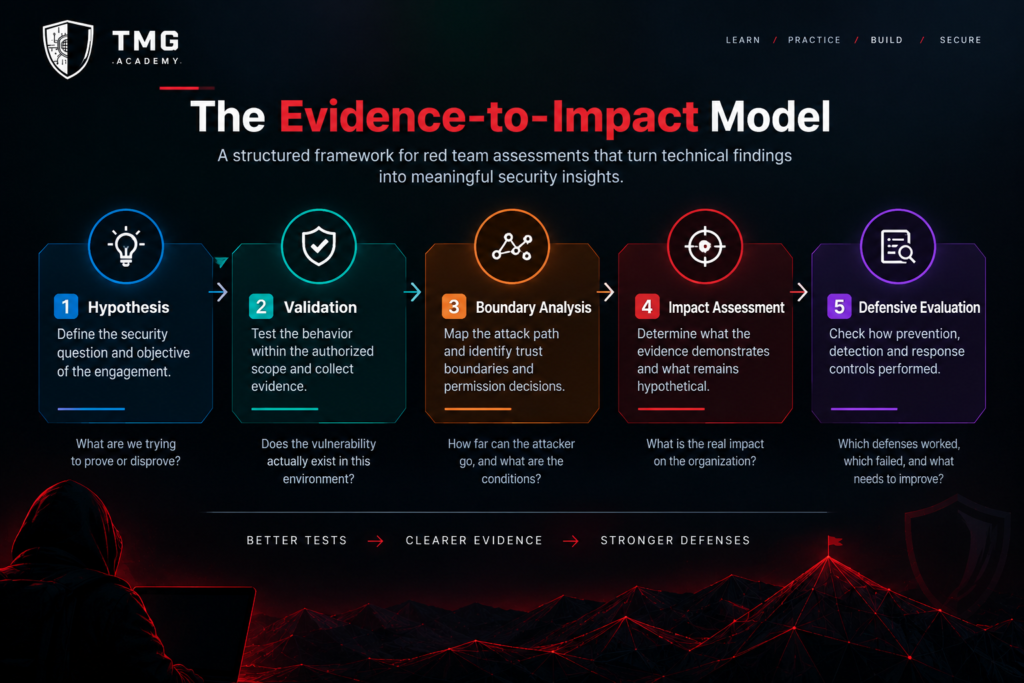
To improve the quality of red-team reporting, I propose an Evidence-to-Impact Model consisting of five stages:
<ol start="1">
Hypothesis: State the security condition being tested.
Validation: Establish whether the condition exists within the authorized scope.
Boundary analysis: Determine which trust or authorization decisions affect the outcome.
Impact assessment: Establish what the evidence demonstrates and what remains hypothetical.
Defensive evaluation: Determine which preventive, detective, and response controls behaved as expected.
</ol>
This is a proposed assessment model, not an established industry standard. It is intended to make the reasoning behind a finding more transparent and repeatable.
Example: An authorization weakness
Suppose a test account can access a record that should be restricted to another test account.
A weak report might simply state that the application has an insecure direct object reference and assign a severity level.
A stronger report would document:
-
The security requirement that was expected to be enforced.
-
The authorized test identities and records involved.
-
The observed access-control behavior.
-
The evidence confirming that the restriction failed.
-
The type of information or operation exposed by the validated behavior.
-
Whether related records or functions were actually tested.
-
The recommended control change and the method for verifying the fix.
The report should not claim access to an entire database when the evidence establishes only unauthorized access to one designated test record.
This discipline makes findings more useful to developers, security engineers, and decision-makers.
It also makes retesting more precise because the expected behavior is explicitly defined.
5. Red Teaming and Detection Engineering Must Meet
An assessment that examines only the offensive result leaves an important question unanswered:
What could the defensive team observe?
A security control may prevent an action, generate an alert, record an event without alerting, or fail to capture the relevant activity entirely.
Those outcomes have different implications.
MITRE ATT&CK provides a common vocabulary for describing adversary tactics and techniques, while its adversary-emulation resources help teams organize controlled tests around documented threat behavior. <Cite refs={["turn314315search6","turn314315search13"]}/>
However, mapping an activity to ATT&CK does not itself prove that a detection exists or works. That must be established through testing.
A useful evaluation separates three questions.
Prevention: Was the tested action blocked by the relevant control?
Detection: Did the monitoring system produce the expected event or alert?
Response: Did the responsible team interpret the evidence correctly and follow the intended procedure?
These outcomes should be recorded independently.
For example, an action may be successfully blocked while generating no useful alert. Alternatively, a detection may fire correctly even when the preventive control fails.
Neither situation should be reduced to a single pass-or-fail result.
A well-designed red-team exercise makes these differences visible and turns them into actionable improvements.
6. Build a Repeatable Test Without Chasing Evasion
Professional red-team work should not be measured by how many security products a tester can bypass.
The objective is to test defined security assumptions under controlled conditions, with enough documentation to support independent review.
A practical exercise can follow this sequence.
Phase 1: Define the scope
Document the approved systems, accounts, test window, permitted techniques, prohibited actions, data-handling requirements, and stop conditions.
Establish who can authorize changes to the scope and who should be contacted if unexpected impact occurs.
Phase 2: Establish the baseline
Record the relevant control configuration, expected logging behavior, and existing detection coverage.
Without a baseline, it may be impossible to determine whether a test caused a change or whether a control was already operating incorrectly.
Phase 3: Select a testable behavior
Choose a low-impact, representative action appropriate to the objective and environment.
Use designated test accounts and non-sensitive test data wherever possible.
Phase 4: Collect evidence
Capture the relevant application responses, event records, timestamps, test identifiers, and control outcomes.
Preserve the evidence according to the organization's handling requirements. Avoid collecting unrelated personal or confidential information.
Phase 5: Compare expected and observed results
Document whether the action was permitted or denied, which events were generated, whether the expected detection occurred, and how the response process performed.
Record uncertainty explicitly.
Phase 6: Remediate and retest
Agree on a corrective action, repeat the relevant test after the change, and verify that the intended behavior now occurs.
A finding should not be marked as resolved solely because a configuration was changed. The security property must be tested again.
This process aligns with the broader principle in NIST SP 800-115: security testing should be planned, conducted, analyzed, and connected to appropriate mitigation strategies. <Cite refs={["turn314315search1","turn314315search2"]}/>
7. Measure What Actually Improved
A report containing dozens of findings may look impressive, but the number of findings alone does not establish the quality of an assessment.
A more useful approach evaluates whether the engagement produced reliable evidence and measurable improvements.
Consider the following metrics.
<table>
<tbody>
<tr>
<th>Metric</th>
<th>What it measures</th>
</tr>
<tr>
<td>Objective coverage</td>
<td>The proportion of approved test objectives supported by documented results</td>
</tr>
<tr>
<td>Evidence completeness</td>
<td>Whether each finding contains sufficient evidence to support its conclusion</td>
</tr>
<tr>
<td>Detection coverage</td>
<td>Whether expected telemetry and detections were observed for defined test behaviors</td>
</tr>
<tr>
<td>Response time</td>
<td>The time taken to perform a specified response action, measured against an agreed baseline</td>
</tr>
<tr>
<td>Remediation verification</td>
<td>Whether corrective actions were confirmed through repeat testing</td>
</tr>
<tr>
<td>Residual risk</td>
<td>The important risks that remain after validated fixes and compensating controls</td>
</tr>
</tbody>
</table>
These metrics require context.
For example, high objective coverage does not necessarily mean that every security weakness was discovered. Detection coverage for a handful of simulated behaviors does not establish comprehensive detection against all threats.
Similarly, a faster response time is meaningful only when the measured response action and starting point are consistently defined.
The purpose of measurement is not to produce impressive numbers. It is to help the organization make better security decisions.
8. The Reporting Standard: Separate Facts, Inferences, and Unknowns
One of the most valuable skills in ethical hacking is knowing exactly what the evidence supports.
Professional reports should distinguish three categories.
Observed facts: Directly demonstrated behavior, supported by reproducible evidence.
Reasonable inferences: Conclusions supported by the observations but not directly demonstrated in full.
Unverified possibilities: Potential consequences that require additional testing or evidence.
For example, unauthorized access to one test record may demonstrate an access-control failure. It may suggest that other records are affected, but that broader conclusion requires further validation.
Clear separation of these categories improves technical credibility and helps organizations prioritize remediation without exaggerating the finding.
A strong report should also include limitations, affected components, reproducibility conditions, remediation guidance, and a method for verifying the fix.
The best reports do more than explain how a tester found a problem. They give the organization enough information to understand, correct, and verify it.
9. The Professional Red Teamer's Responsibility
Authorization is not a checkbox added after planning.
It is a condition that shapes the entire engagement.
A professional assessment should establish the permitted scope, minimize unnecessary access to sensitive information, protect collected evidence, and stop when an unexpected condition creates unacceptable risk.
If a finding can be validated with a harmless test record, accessing real customer records may add risk without adding meaningful evidence.
If an application authorization check can be tested with designated accounts, testing against unrelated users is not necessary to establish the core behavior.
This is not merely a legal or ethical consideration. It is a matter of test quality.
An assessment that causes avoidable disruption or collects unnecessary sensitive data can create new risks while attempting to measure existing ones.
The objective is to obtain sufficient evidence with the minimum necessary impact.
Conclusion: Make Every Finding Answer a Security Question
Red teaming is most valuable when it tests an organization's security assumptions rather than merely demonstrating technical capability.
A successful assessment connects a defined hypothesis to a validated behavior, establishes the boundaries of what was proven, examines the relevant defensive controls, and produces evidence that supports corrective action.
The Evidence-to-Impact Model offers one way to structure that process:
Define the hypothesis. Validate the behavior. Analyze the trust boundary. Establish the impact. Test the defenses. Verify the remediation.
The result is a more useful form of red-team reporting: one that helps technical teams correct weaknesses and helps leadership understand what the evidence means for the organization.
The real value of ethical hacking is not measured by the number of tools used, the complexity of the techniques attempted, or the dramatic appearance of a demonstration.
It is measured by the quality of the conclusions, the reliability of the evidence, and the improvements the organization can verify afterward.
An exploit can demonstrate a weakness. A disciplined assessment explains its significance—and proves whether the organization became more secure.
References and Further Reading
<ol start="1">
MITRE ATT&CK — Adversary Emulation and Red Teaming: https://attack.mitre.org/resources/get-started/adversary-emulation-and-red-teaming/
MITRE ATT&CK — Adversary Emulation Plans: https://attack.mitre.org/resources/adversary-emulation-plans/
NIST SP 800-115 — Technical Guide to Information Security Testing and Assessment: https://csrc.nist.gov/pubs/sp/800/115/final
</ol>
Author's note: The Evidence-to-Impact Model is a proposed framework for organizing authorized security assessments. It is not an official MITRE or NIST methodology. Any practical findings should be based on tests performed in systems for which the author has explicit permission.
 🎓 Want to go deeper?Bug Bounty Hunting ( Real World Scenarios )Hands-on course by TMG Security →
More from the TMG Security blog
Community posts reflect the author's own experience. Only test systems you have permission to test.
